
WhatsApp Lead Qualification: Build a Chatbot People Will Finish
Collect the smallest useful set of answers and make the next human response easier.

On this page
A useful WhatsApp lead qualification chatbot asks only the questions needed to guide the next step. Start with the customer’s goal, collect a few relevant details, and pass a clear summary to the right person.
The chatbot should make it easier to get help. If it feels like a long application form, people may leave before your team learns anything useful. If it asks too little, an agent has to restart the conversation.
This guide shows how to design the conversation before building it. It uses FreshNest Cleaning, a fictional service business. The flow is an illustrative design, not a claim that a specific automation has already been configured in your Botbiz account.
Define a qualified lead in plain language
Avoid starting with a lead score. First describe the kind of enquiry your team can usefully act on. FreshNest might need to know the requested service, whether the address is in its service area, and when the customer hopes to start.
That gives the business a working definition: “A person requesting a service we provide, in an area we cover, with enough timing information for our team to discuss availability.” It is specific enough to guide the questions without pretending the chatbot can make the final sale.
Separate eligibility from interest. Someone outside your service area may be interested but cannot currently book. Someone comparing options may be a good fit without being ready today. Store those distinctions so the next person does not treat every incomplete chat as a lost opportunity.
Start with a helpful opening
Tell the customer what the conversation will do. A short opening lowers the effort of answering and sets a clear expectation.
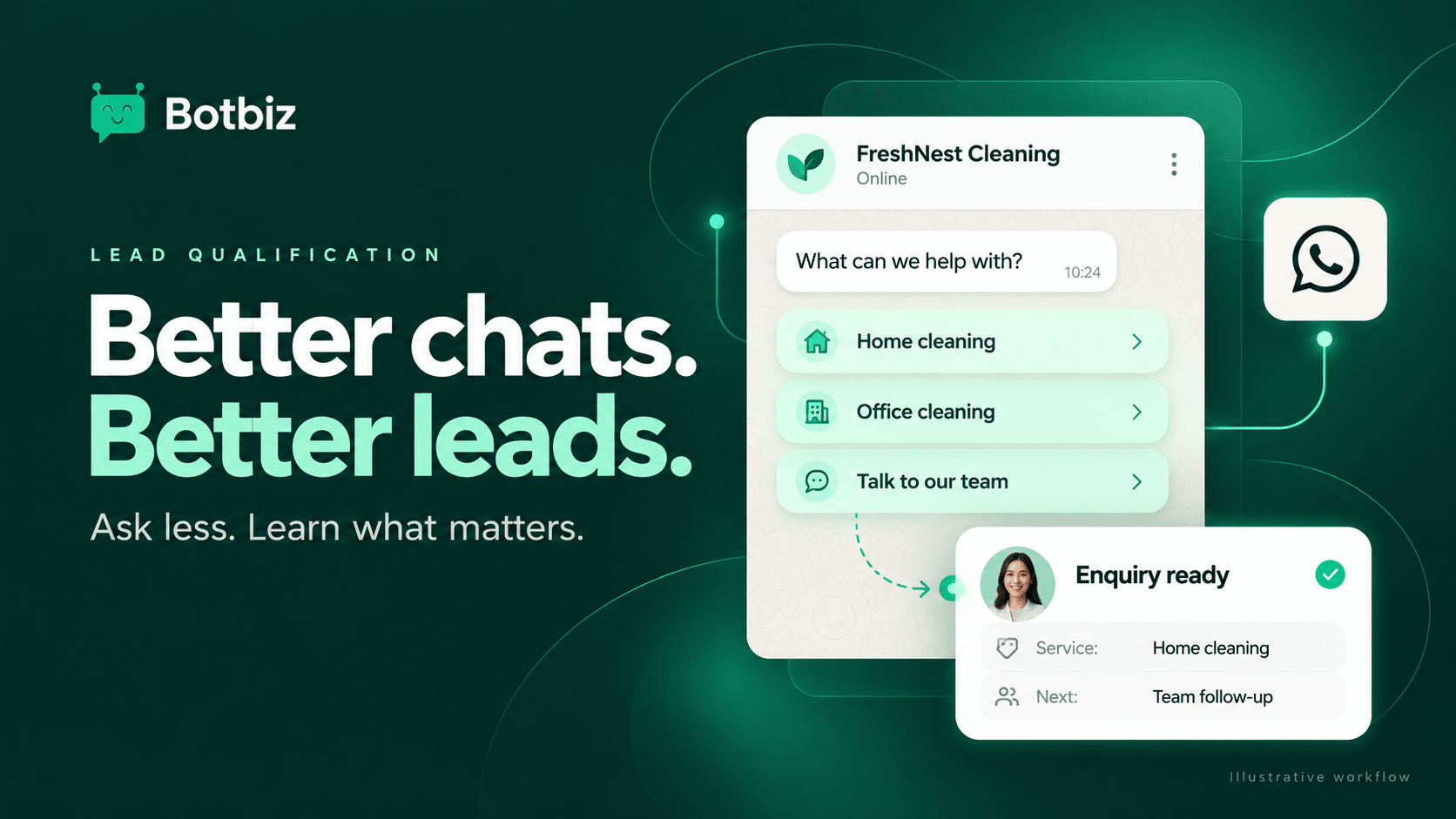
Illustrative opening: Hi, this is FreshNest’s automated assistant. I can ask a few questions to help our team recommend the right cleaning service. What would you like help with?
Offer a small set of common choices if that helps the decision: a one-off home clean, a regular home clean, or a question for the team. Keep an escape route for people whose request does not fit.
Do not force existing customers through a new-lead flow when they need to change a booking or report a problem. The opening should distinguish a new enquiry from service support early enough to prevent frustration.
Ask questions in the order a person would
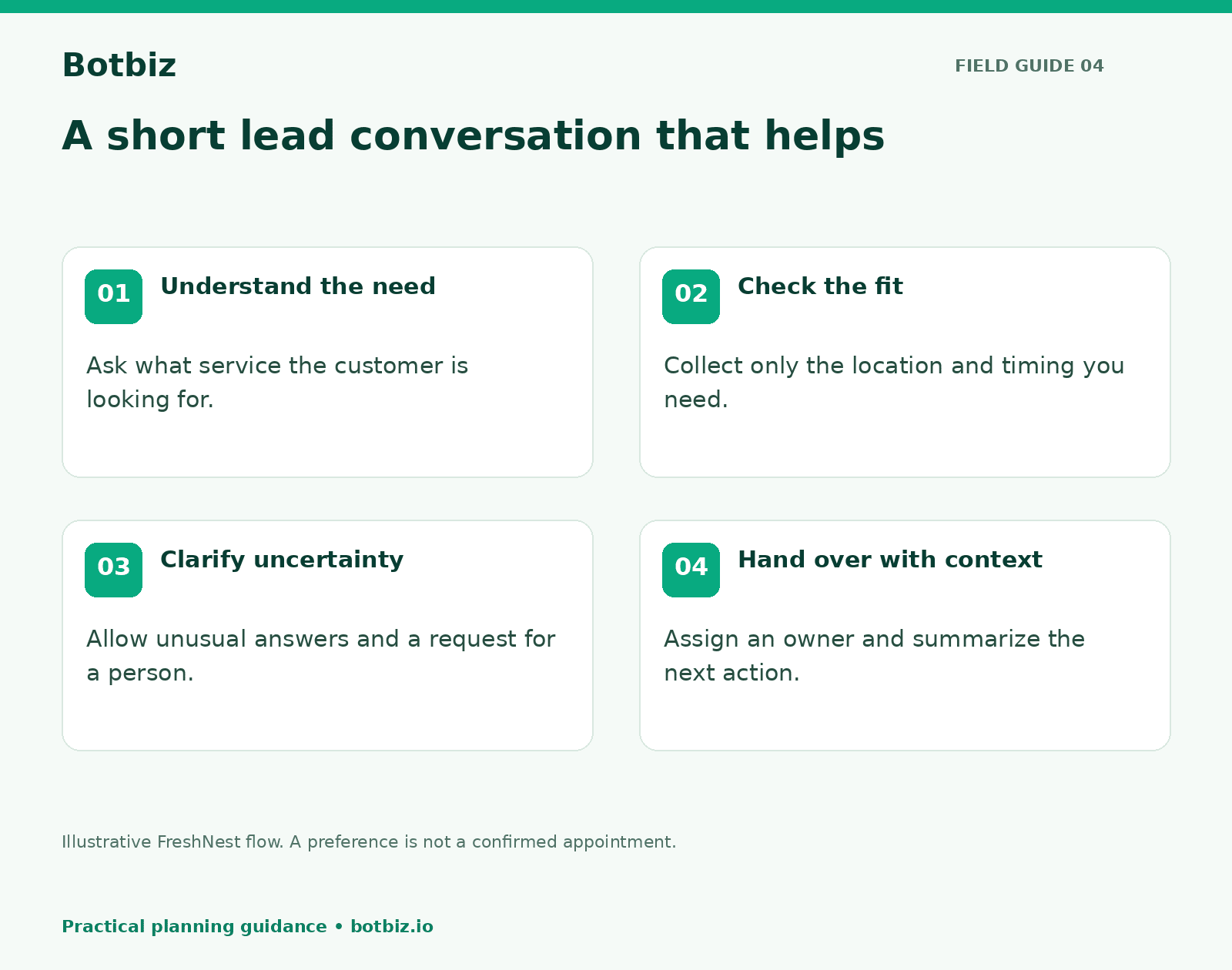
For FreshNest, a sensible sequence is service, location, and timing. A budget or property detail may be useful later, but it should earn its place in the conversation.
| Question | Why it matters | What happens next |
|---|---|---|
| What service do you need? | Identifies the relevant team or offer | Show only relevant follow-up questions |
| Which area are you in? | Checks whether the business can help | Continue or explain the coverage limit |
| When would you like to start? | Helps the team prioritize the enquiry | Record a preference without promising a slot |
| Would you like a person to help? | Gives the customer control | Route the conversation with its context |
Ask one question at a time. “What service, location, property size, budget, and date do you need?” saves the bot a turn but creates more work for the customer. It also makes partial answers difficult to interpret.
Use plain language and explain unfamiliar terms. “One-off clean” is easier to answer than an internal service code. If you need a technical detail, add a short example and allow “I’m not sure.”
Branch only when the answer changes the next step
A branch is useful when it prevents an irrelevant question or sends the customer to a different route. For instance, a regular-cleaning enquiry may need preferred frequency, while a one-off clean may need an approximate date.
Avoid branching just because the software allows it. Every extra route needs copy, testing, maintenance, and a way back when the customer changes their mind. A small flow with clear answers is usually easier to improve than an elaborate tree nobody fully understands.
Botbiz’s visual chatbot builder describes conditional flows and collected user inputs. Use those capabilities to implement a written conversation map after the team agrees on the questions and outcomes.
Design for messy answers
Real customers do not always press the expected button. They send two answers together, type a neighborhood nickname, make a spelling mistake, or ask a question halfway through. Your design should account for that normal behavior.
For a location question, clarify an ambiguous answer instead of immediately rejecting it. For a date, record an approximate preference if an exact day is not necessary. For “How much does it cost?”, explain what information the team needs to provide an accurate quote.
After repeated misunderstanding, offer a human route. A bot that keeps repeating the same menu is not collecting better information; it is creating a barrier. Keep the customer’s previous answers available so they do not have to start again.
Do not ask for private information simply because it might be useful later. Collect what is needed for the next step. For a cleaning enquiry, an area may be enough for initial routing; a complete address can wait until it serves a clear booking purpose.
Make the handoff useful to both people
The customer should know what happens next, and the agent should receive a readable summary. “Your request has been received” is less helpful than an honest explanation of who will respond and during which working hours.
A good handoff note might look like this:
Fictional lead summary: Regular home cleaning requested. Area: Northside. Preferred start: next month. Customer asked about weekly pricing. No appointment confirmed. Next action: discuss service options and availability.
Notice the distinction between a preference and a promise. The chatbot has collected the requested start period; it has not booked a visit. That difference helps prevent an agent from inheriting an expectation the business cannot meet.
Use a Botbiz team inbox to organize the human conversation. Decide who owns new enquiries, who covers absences, and how the team spots leads waiting for a response. A handoff is incomplete if nobody is responsible for receiving it.
Test the conversation before inviting customers
Write a small set of realistic test conversations. Include a straightforward enquiry, an unsupported area, an existing customer with a complaint, a person who changes an answer, and someone who asks for a human immediately.
For each test, check the saved information and the final destination. It is possible for a conversation to look correct on the phone while storing the wrong service label or leaving the agent without the last answer.
Also test interruptions. What happens if someone returns later? Does the flow restart unnecessarily? Does a human reply while the bot continues asking questions? Resolve these interactions in your actual configuration rather than assuming the default behavior matches your intended process.
Where data needs to move into another system, inspect the relevant Botbiz integrations and confirm the required fields. Keep a simple failure route so a technical problem does not silently discard an otherwise useful enquiry.
Measure progress at each question
Track how many people start, reach the final step, receive a human response, and progress to the business outcome you care about. Also note where they leave or ask for help. Completion alone does not tell you whether the resulting leads are useful.
If many people stop at a budget question, consider whether it is unclear, premature, or unnecessary. If agents repeatedly ask for one missing detail, consider adding it earlier. Change one part of the flow at a time so you can understand the effect.
Review transcripts with the people who handle the enquiries. They will often spot awkward wording and missing context that a dashboard cannot explain. Keep the flow owner responsible for making those improvements and checking them after changes.
Start with one service and one clear outcome
Your first version does not need to qualify every possible enquiry. Start with the most common service, collect the smallest useful set of answers, and make the human handoff reliable.
Explore the Botbiz chatbot builder with that conversation map in hand. A flow people can finish and your team can act on is a stronger foundation than a large bot built around hypothetical questions.
Scale Your Business with WhatsApp Cloud API
Get 0% markup fees on Meta API, visual drag-and-drop chatbot builder, shared live team inbox, and 100+ app integrations with Botbiz.