
WhatsApp Drip Campaigns: Follow-Up Sequences That Respect Customers
Make every scheduled message earn its place in the customer’s journey.

On this page
A WhatsApp drip campaign is a planned sequence of messages sent over time. A useful sequence has a clear entry condition, a reason for every message, and rules that stop it when the customer replies, converts, opts out, or no longer fits the journey.
The schedule is only one part of the design. What matters is whether the next message still makes sense when it is due. A person who has already booked should not receive another invitation to book the same service.
This guide shows how to plan a sequence your team can maintain. It uses FreshNest Cleaning, a fictional business, and suggested timings for illustration rather than universal best-send times.
Start with a customer decision, not a message count
Choose a specific journey. “Follow up with everyone” is too broad. “Help people who requested information about weekly cleaning decide whether to discuss a plan” gives the team something concrete to design.
Write down the decision the customer is trying to make. They may need to understand the service scope, compare options, or find an available appointment. Each message should remove one real obstacle to that decision.
Avoid deciding that every sequence must have five or seven messages. If two useful messages cover the need, stop there. More steps create more copy to maintain and more opportunities to contact someone after their situation has changed.
Define exactly who enters
An entry rule should identify the event, the relevant audience, and the necessary permission. For FreshNest, the event might be a customer requesting information about a regular service and agreeing to related follow-up.
Keep a record of the context that makes the sequence appropriate. A person who asked one urgent support question should not automatically enter a sales journey. A person who requested information about a one-off clean should not receive messages about a recurring plan unless that topic is relevant.
Botbiz’s drip campaign tools describe delayed message sequences and conditional follow-up. Map your intended entry and exit logic first, then confirm how those rules are implemented in the actual account and integrations you use.
Give each message a different job
Here is an illustrative three-step plan for an interested FreshNest enquiry. The timings are a starting hypothesis to test, not a claim about what works best for every business.
| Stage | Suggested timing | Message job | Example action |
|---|---|---|---|
| Helpful introduction | After the requested information is available | Explain the relevant service | Read what is included |
| Decision support | Two days later, if still appropriate | Answer a common unresolved question | Ask about weekly versus fortnightly visits |
| Gentle close | Several days later, if still eligible | Offer one final route to help | Request a conversation or end follow-up |
Do not repeat “Just checking in” at every stage. If there is nothing new or useful to say, reconsider the message. A sequence should help the customer decide, not merely remind them that the business wants a response.
Write as though a person will reply
Use a recognizable business name, explain the context, and make the next action easy to understand. Avoid pressure, invented scarcity, or language that assumes a booking exists when the customer has only asked a question.
Illustrative follow-up: Hi Asha, you asked FreshNest about regular home cleaning. Would it help to compare weekly and fortnightly visits? Reply with the option you are considering and our team can explain what is included.
Illustrative closing message: If you still want help choosing a cleaning plan, reply here and our team can assist. We will end this follow-up sequence after this message. Reply STOP if you do not want further marketing messages.
These are writing examples, not approved templates. Review the appropriate message category and template requirements for the actual use. Meta’s marketing-message guidance is relevant when the sequence encourages a purchase or renewed engagement.
Build stop rules before setting delays
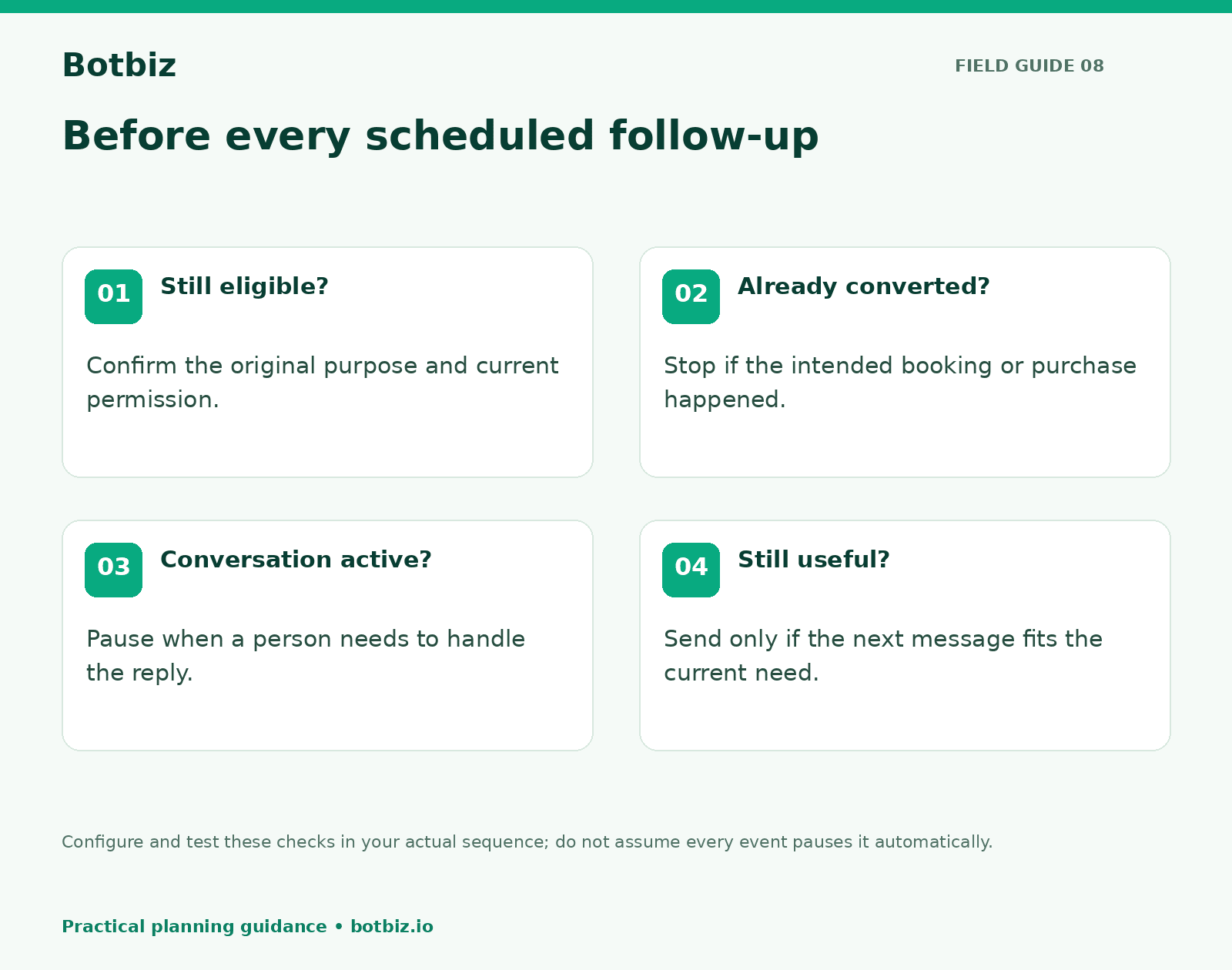
For every scheduled step, ask what could make it inappropriate. The customer may have booked, replied with a different need, requested no further contact, or opened a support issue. Check those conditions as close to the send as your workflow allows.
For FreshNest, the key rules might be:
- Stop the sales sequence when a booking is confirmed in the source system.
- Pause automated follow-up when a person begins an active conversation.
- Suppress future marketing after an opt-out request.
- Stop when the requested service is unavailable or the lead no longer fits the journey.
- End after the planned final step rather than looping indefinitely.
These are design requirements to configure and verify. Do not assume that every reply, booking, or external-system change automatically pauses every campaign. Ask your implementer to demonstrate each route using a test contact.
Coordinate sequences with broadcasts
A customer experiences all your messages together, even if separate teams created them. A sensible drip sequence can become excessive when a broadcast and another automation arrive during the same period.
Maintain a shared view of active journeys. Decide which types of messages take priority and which should wait. Operational updates about a current order may require different treatment from a promotional follow-up.
Review the Botbiz broadcasting options alongside your sequence plan. Use relevant audience exclusions and an agreed contact-frequency approach where your configuration supports it. Keep the rules understandable enough that a new team member can follow them.
Prepare the human reply path
Decide who receives replies and what context they need. An agent should know which message prompted the response and what the customer previously asked. That prevents a helpful reply from restarting the sales conversation unnecessarily.
Use a shared team inbox to organize the work. If the customer says “Can someone call me tomorrow?”, record the request and make the next action explicit. Do not leave the drip campaign running while a teammate assumes the conversation is paused.
Set honest working-hour expectations. A sequence that invites a question at a time when nobody can help may create avoidable waiting. Choose timing with team coverage and the customer’s timezone in mind.
Test the sequence as a changing conversation
Testing only the first message misses most of the risk. Run through the complete journey with a test contact and deliberately change its state between steps.
Confirm a booking before the second message. Reply after the first message. Opt out after a later step. Change the relevant source record. Then verify that the next action matches the intended rule.
Also check duplicate entry. If the same person submits the same enquiry twice, should they enter twice, restart, or remain in their existing journey? Define the answer before an import or repeated event creates overlapping sequences.
Measure useful outcomes at each stage
Track entry, message delivery where available, replies, meaningful conversions, exits, and negative feedback. Review what happened at each step rather than judging the sequence only by its total message count.
A high reply count can mean interest, confusion, or annoyance. Read a sample of conversations to understand which it is. If one message repeatedly prompts “I already booked,” repair the stop rule before testing new copy.
Use a consistent business outcome, such as a confirmed booking, and acknowledge attribution limits. A person may convert through another channel after several interactions. Keep your reporting honest about what you can observe.
Start small and maintain the sequence
Launch one journey with a few purposeful steps. Name an owner to review the copy, destinations, entry rules, and stop conditions when your service changes. A sequence left running without maintenance can become outdated quietly.
Explore Botbiz drip campaigns with a written journey and a test plan. The strongest follow-up is the one that still makes sense when the customer receives it.
Scale Your Business with WhatsApp Cloud API
Get 0% markup fees on Meta API, visual drag-and-drop chatbot builder, shared live team inbox, and 100+ app integrations with Botbiz.